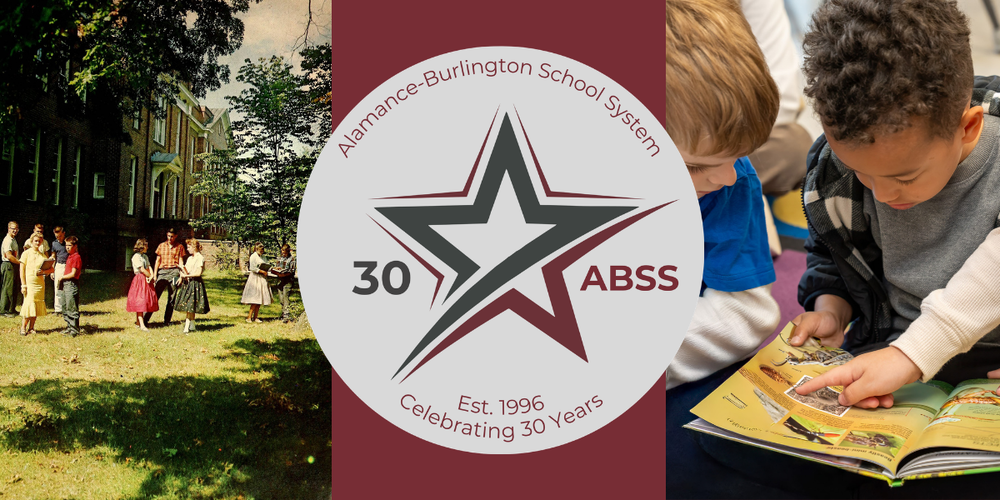
In education, 30 years is a milestone that marks a full generation. It is the time it takes for a kindergartener to grow up, walk across the graduation stage, enter the workforce, and proudly send their own children back through our school doors.
As we celebrate the 30th anniversary of the Alamance-Burlington School System, we look back at a monumental chapter in our community's history. On July 1, 1996, two independent public school districts with rich traditions and deep community roots joined forces. In their place arose a single, unified district built to serve all children of Alamance County.
The road to that historic day was a true community journey, one filled with careful planning, collaborative compromises, and a shared vision for the future. This is the story of how our district came together to build a legacy of excellence.
Two Paths, One Shared Mission
Before the summer of 1996, a student's educational experience was guided by two distinct, parallel systems operating side-by-side: Alamance County Schools and Burlington City Schools.
Alamance County Schools (Organized in 1923)
While individual rural schoolhouses existed throughout the 1800s, the centralized Alamance County Board of Education was formally organized in 1923 during the state’s early consolidation movement. Serving the rural and unincorporated areas across the county’s expansive geography, this system eventually managed 21 schools. Because of the wide physical distance between campuses, individual schools operated with a high degree of local leadership and strong community ties. The district was widely recognized for its robust vocational and technical training programs, ensuring students were career-ready, and maintained comprehensive county-wide bus transportation to serve every neighborhood.
Burlington City Schools (Chartered in 1893)
Born out of the rapid industrial and railroad boom of the late 19th century, the North Carolina General Assembly officially chartered the Burlington Public School District in 1893, opening its first graded school on Broad Street. Centering on the urban municipality of Burlington, this system grew to manage 11 schools. Financed in part by a local supplemental tax, the district was characterized by an administrative focus on specialized curriculum enhancements. Generations of families fondly remember the district's acclaimed fine arts and orchestra programs, pioneering investments in school library technology, and an expanded roster of Advanced Placement courses.
The Merger
Bringing two distinct educational cultures together required incredible dedication from local leaders, educators, and parents. The formal planning kicked off in 1994 when the Alamance County Commissioners approved a formal "Plan of Merger."
To ensure the community was fully invested in this new chapter, state and local leaders worked together to place the final decision directly in the hands of the people. On May 7, 1996, voters officially approved the referendum, giving the green light to create a unified school system.
Behind the scenes, a dedicated interim school board, chaired by Jack G. Watts, spent a year blending administrative staffs, aligning curriculums, and hammering out a unified budget. Their goal was simple: make the transition seamless for families.
When opening day arrived on July 1, 1996, the old boundaries dissolved. The newly born Alamance-Burlington School System instantly became one of the largest and most dynamic districts in North Carolina, serving roughly 20,000 students across 32 schools. Dr. Joseph Sinclair, who had been leading the city schools, was tapped as the first superintendent of the unified system, bringing a steady hand to the transition. To keep things familiar for students, the board kept all existing school attendance zones exactly as they were, allowing families to transition into the new district with peace of mind.
The merger allowed the district to take the finest elements of both systems and spread them county-wide. Rural campuses gained access to expanded technology and arts funding, while urban schools benefited from a broader, streamlined county infrastructure. It also allowed the new district to build a brighter, more equitable future. The school board worked diligently with state and federal guidelines to ensure that resources, facility upgrades, and educational opportunities were distributed fairly across every neighborhood. After a comprehensive review, federal officials recognized that ABSS had successfully created a fully integrated, equitable system for all students, honoring the truest spirit of public education.
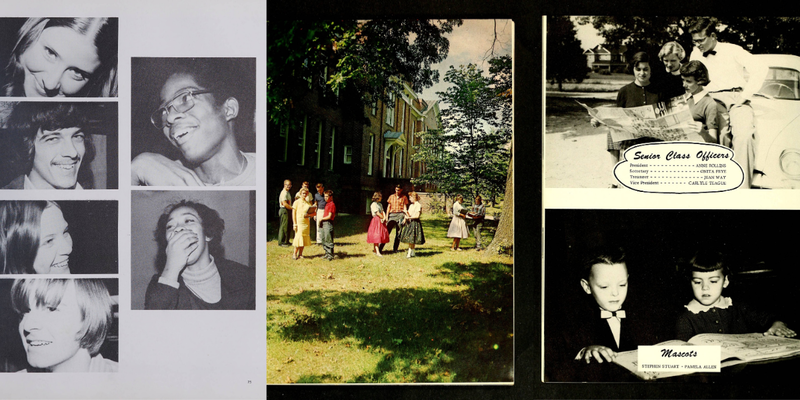
Left to right: Yearbook photo from Hugh M. Cummings High School (1973), Mebane High School (1959), and Sylvan High School (1954).
The Historic School Roll Call: Past and Present
To truly honor our history, we recognize the campuses that founded the unified district on July 1, 1996, alongside the deep structural roots of our community.
The Burlington City Schools Footprint (11 Active Campuses at Merger)
High Schools: Hugh M. Cummings High, Walter M. Williams High. (Note: Historic Burlington High preceded Williams High before moving to the current campus site in 1951).
Middle Schools: Broadview Middle, Turrentine Middle.
Elementary Schools: Eastlawn Elementary, Grove Park Elementary, Harvey R. Newlin Elementary, Hillcrest Elementary, Marvin B. Smith Elementary, and R. Homer Andrews Elementary.
Specialized Campuses: Sellars-Gunn Education Center.
The Alamance County Schools Footprint (21 Active Campuses at Merger)
High Schools: Eastern Alamance High, Graham High, Southern Alamance High, and Western Alamance High.
Middle Schools: Graham Middle, Hawfields Middle, Western Alamance Middle, and Woodlawn Middle.
Elementary Schools: Alexander Wilson Elementary, Altamahaw-Ossipee (A.O.) Elementary, B. Everett Jordan Elementary, E.M. Yoder Elementary, Edwin M. Holt Elementary, Elon College Elementary (now Elon Elementary), Garrett Elementary, Haw River Elementary, North Graham Elementary, South Graham Elementary, South Mebane Elementary, Pleasant Grove Elementary, and Sylvan Elementary.
Historic Foundational Campuses (Pre-Merger & Segregation Eras)
To truly honor our history, we recognize the deeply beloved community schools that paved the way for generations of families prior to the consolidation movements of the mid-20th century:
Burlington High School (1924–1951): Serving for decades as the city's flagship high school on Broad Street, Burlington High set the standard for academic and athletic excellence in the early 20th century. As the student population swelled following World War II, the district built Walter M. Williams High School on the former Piedmont Country Club property. In spring 1951, the final graduating class of Burlington High held its commencement on the stage of the new Williams High auditorium.
The Northern Consolidation (Altamahaw-Ossipee, Elon, and Pleasant Grove High Schools): Operating for decades as vital "union schools" (grades 1–12), these three rival 1A campuses anchored the northern end of the county, serving local agricultural and textile mill communities. Following a successful 1958 bond, their high school segments were consolidated in July 1962 to form Western Alamance High School (with students famously voting on navy and white as their colors and the "Warrior" as their mascot). The historic A.O. and Pleasant Grove facilities were subsequently preserved to serve as elementary pillars.
The Southern Consolidation (Alexander Wilson, E.M. Holt, Eli Whitney, & Sylvan High Schools): Prior to 1960, the southern region of Alamance County relied on a network of proud rural union schools. Alexander Wilson High School (established in 1922), E.M. Holt High School, Eli Whitney High School, and Sylvan High School anchored their respective communities for generations. On December 12, 1960, these four high school segments were formally consolidated to open the new Southern Alamance High School. The original campuses at Alexander Wilson, E.M. Holt, and Sylvan were preserved to serve as elementary pillars, while Eli Whitney remained a beloved community landmark.
Central Alamance High School: Operating from August 1961 to June 1968, this institution on Trollinger Road in Graham was formed by merging Graham Negro High School and Pleasant Grove Union High School. In December 1963, it achieved legendary status by becoming the first Black high school in the state of North Carolina to receive official accreditation from the Southern Association of Colleges and Schools (SACS). In August 1968, the campus transitioned into the newly integrated Graham High School.
Jordan Sellars, J.F. Gunn, and Alamance Training School: We proudly honor the rich lineage at Apple and Rosenwald streets in Burlington. Rooted in the early 20th-century movement led by Booker T. Washington and Julius Rosenwald to educate Black children, this historic site housed the Alamance Training School (1928), J.F. Gunn Elementary (1942), and Jordan Sellars High School (1954). Prior to desegregation, these institutions provided exceptional education, culture, and leadership for the city’s African American community. Following integration, the campus was repurposed as the Sellars-Gunn Education Center, serving as an active alternative education campus when ABSS was formed in 1996.
The Ray Street School (Graham High School): Built in the early 1930s at 609 Ray Street in Graham, this historic institution served as the educational, cultural, and civic hub for Black students in Graham throughout the era of segregation. Following the 1961 transition to Central High and the subsequent integration of the district, the historic building remained a staple of community education. Today, it proudly serves as Ray Street Academy and houses an active historical museum preserving its legacy.
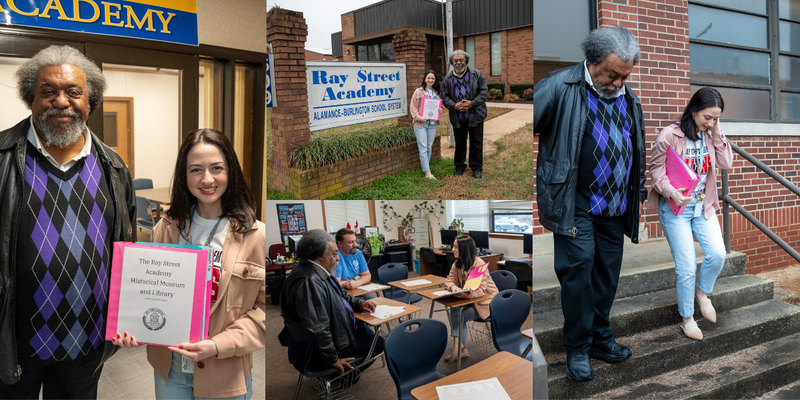
Ray Street High School Social Studies teacher, Mary Moorhouse, is leading the effort to create The Ray Street Academy Historical Museum and Library, in collaboration with James Shields, curator of the African-American Cultural Arts & History Center. Read more about the Museum progress and the history of Graham High School.
Mebane High School: Formally consolidated in 1933 from the older Mebane, Woodlawn, and Hebron schools, the proud Mebane High Tigers dominated regional athletics for decades. They graduated their final senior class in 1962 before integrating into the newly constructed Eastern Alamance High School footprint.
Sylvan School (Snow Camp): Holds the historic distinction of organizing the oldest high school curriculum in the county (1908) and standing as the very first consolidated rural public school building in North Carolina (1903). It anchored the southern end of the county for generations before transitioning into an elementary campus.
Eli Whitney School: A bedrock of its southern rural community, operating for decades as a true union school before the 1960s high school consolidation reshaped the southern district footprint.
The McCray School (1915–1951): A historic, preserved one-room schoolhouse on NC Highway 62 that provided vital elementary education to African American children in the northern county line for over three decades. It was placed on the National Register of Historic Places in 1986.
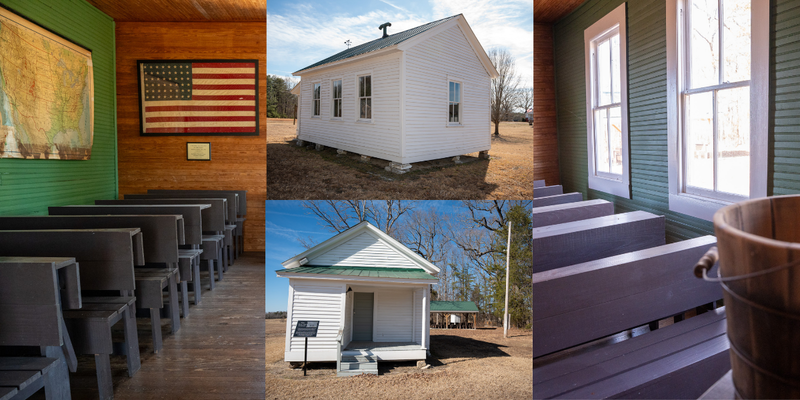
The McCray School received a new lease on life thanks to community volunteers and the Alamance County African-American Cultural Arts and History Center with renovation expertise provided by Old Callands Post Office Restoration, a non-profit organization committed to preservation of community treasures. Students from our Career & Technical Education carpentry program built seats for the outdoor classroom area.
ABSS Today: 30 Years of Pride
It has been three decades since that historic vote. What began as a 32-school consolidation has grown into a modern system of 38 schools, encompassing 20 elementary schools, 7 middle schools, 7 high schools, the Career and Technical Education Center (CTEC), Alamance Virtual School, Ray Street Academy, and the Early College at Alamance Community College.
Today, ABSS serves over 22,000 students and stands proudly as the second-largest employer in Alamance County.
Whether you are a student, a parent, a retired educator who remembers the transition, or a brand-new teacher stepping into the classroom this year, you are a part of this 30-year legacy. This is ABSS!